Friday, July 5, 2013

Tips to Buy chemistry lab equipments

In chemistry labs some devices are needed to conduct various essential experiments. Without chemistry lab equipments, it is not possible to accomplish required experiments. Always purchase CCR certified equipments.

High quality chemistry experiment devices are required to get accurate results in chemistry labs. In fact all types of laboratories need scientific equipments to conduct experiments. Lab equipments that are of  prescribed quality and meet required specifications permit scientist  to carry out practical applications with the perfect accuracy.

While purchasing Chemistry lab equipments, it is very essential to consider some factors such as technical features, type of metal used for making equipments, brand, code of the equipments and analytical application that are to be carry out on these devices. 

You can buy these devices directly from manufacturers or you can also buy such equipments from any online store. Online centers provide the facility to select products of  multiple manufacturers and you can also compare features and rates of such products online before making an order. The products you purchase must  meet ISO standards.

Most common chemistry laboratory equipments are glassware, thermometers, microscopes, hematology analyzers, electrolyte analyzers, hematology analyzer and various types of measuring Instruments. These devices are based on innovative technology and help scientists to perform sophisticated experiments  with ease in very less time.

Wide range of brand new re-certified chemistry lab instruments are available these days and it is better to use these products for conducting experiments.  

To purchase the standard devices for chemistry experiments, it is essential to focus on various factors. Some of them are:

Device Quality: Ensure to choose standard and certified experiment devices, as they stand out in quality and provide consistent result. These devices can be used for a long time without frequent flaws or maintenance.

Warranty: Certified lab equipments always have some warranty duration, so that the standard products can be rectified for errors. Proper warranty of the products ensure replacement facility at the time of requirements.

Well-known suppliers or manufacturers: always purchase experiment devices from authorized manufacturer or supplier. For this,you can check out company's portfolio. Make sure, whether the company is CCR certified or not. This would ensure standard products at reasonable price. Also check whether the company render maintenance service or not. 

Safety issues: It is very essential to ensure that the devices which you are going to use must be completely safe. The equipments must meet professional safety and according to the health administration regulations.  The devices must meet the guidelines of the state in which it will be used. 

These points help you in selecting and purchasing standard chemistry lab equipments.

Read More: Tips to Buy chemistry lab equipments

Saturday, June 29, 2013

Tips to Choose the Right Biology Equipments


Biology lab equipments are used by biologists in various schools, hospitals, Research labs, colleges and universities for researches and experiment purposes. These equipments serve as a utility in carrying out biological projects in a laboratory by making it easier and possible to observe, dissect and conduct many other functions which a biologist requires to do.

The most basic and most used equipments in a biology lab are as follows:

PETRI DISHES, TEST TUBES AND TUBES

For examining specimens like – bacteria, other micro organisms, mucus, saliva, blood or urine, a biologist needs something to place the specimen in to examine it.

Petri Dishes: if a biologist needs a specimen or sample to grow for him to identify it, he needs it to culture it. A petri dish is used to culture specimens. It is a  shallow plate which is made of glass. Any sample which is to be cultured is placed in the petri dish at a required temperature and then after 24 to 72 hour it is experimented on to figure out which type of organism or life species it is. After sterilizing a petri dish it can be used again and again. Slides:  Samples which are to be viewed under a microscope are spread over a glass slide gently. The slide is treated with a fixative so that the components to not move. The slide is then covered up by a glass cover slip. Test tubes: To test chemical samples or spin a fluid or a mixture of fluids very quickly, test tube is used.

MICROSCOPES:
These are biology lab equipments used  to see organisms and samples more closely. Extremely expensive, they have high-powered lenses which help to see the samples closely through an eye piece. They are available in different powers according to the type of organisms the biologists want to see.

INDCATING AGENTS AND DYES:  Dyes work as a coloring agent which colors the structures of a cell so that it can be viewed easily in the microscope. Some commonly used coloring agents are Iodine and methylene blue. Indicators are papers and solutions which are used to determine the chemical characteristics of a sampled chemical. Determining the acidic value of a chemical is done by using a PH paper which provides a range of colors which estimate the acidic characteristics of a chemical. Other indicator used is litmus paper.

SCALPELS, PROBES, FORCEPS: To Dissect animals or cut them apart in a proper and precise manner to study the body or internal structure, different instruments are  used for cutting the animals and studying their anatomy.

Scalpels: It is a bladed instrument which can neatly cut through skin, muscles and organs.
Forceps: These are a clip like equipment which is used to pick up or lift a structure or tissue.
Probe: It is used to lift a structure or tissue before it is dissected.

BEAKERS, BUNSEN BURNERS AND FLASKS
Chemistry and Biology are interlinked with each other as there are chemical experiments which are also done in a Biology laboratory. Biologists have to mix solutions and chemicals. For mixing the chemicals the following biology lab instruments are used:

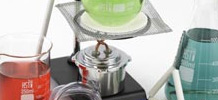
1. FLASKS – A flask has a narrow neck to avoid any spilling out of the solution in it. It is mostly used to transfer a solution stored in it into a beaker. Also it is an alternate container for solution whose container is to be plugged in an experiment.

2. BEAKERS – These are used to pour in mixed solutions into something else. It has a lip shaped point for pouring.

3. BUNSEN BURNERS - This is a heat source which is often used to heat solutions or boil them to the point of becoming gas or getting dissolved. A Bunsen burner is connected to a gas line. A spark ignites the flame in the burner as soon as the gas valve is opened.